Skeet hold points and leads, station by station
Last updated:
Skeet targets fly the same path every time, so every station has a hold point, a break point and a lead that work for most shooters. Here they are for American (NSSA) skeet, with a diagram for each station.
Read this first
- These are starting points, not rules. Coaches differ, and your own hold points will move as your timing settles. Use them, then adjust.
- Leads are perceived leads: the gap you see between the barrel and the target, not the real distance. The real lead on a station 4 crosser is several times larger.
- The numbers assume a maintained (sustained) lead with a 12 gauge. If you swing through from behind, you will see less lead; with the smaller gauges, some shooters see a touch more.
- Hold the gun on the target's flight line, or just under it, at the hold point, and look back toward the house so your eyes pick the target up early.
The field
- Hold
- Break point
- Lead
- High house
- Low house
Every station at a glance
Station 1
High house 1
- Lead
- None
- Hold
- Just under the flight line, about a third of the way out from the house.
The target comes out over your head and is already dropping. Let it come down into the gun and shoot just under it: most misses go over the top.
Low house 1
- Lead
- ≈ 1 ft
- Hold
- On the line, about a third of the way out from the low house.
An easy incomer with a small angle. Keep the gun moving: stopping on it is the usual miss.
Station 2
High house 2
- Lead
- ≈ 3 ft
- Hold
- About a third out from the house, a little under the line.
The hardest high house: fast, close and at a sharp angle. Start ahead of it and don't chase it; misses are almost always behind.
Low house 2
- Lead
- ≈ 1.5 ft
- Hold
- About a third out from the low house, on the line.
A gentle incomer. Read the lead, keep the gun moving and break it near the crossing stake.
Station 3
High house 3
- Lead
- ≈ 3.5 ft
- Hold
- About a third out from the house.
A long crossing angle. Keep the gun moving through the shot; stopping is the usual miss.
Low house 3
- Lead
- ≈ 3 ft
- Hold
- About a third out from the low house.
Another long crosser. Let the target catch up to the gun, then match its speed.
Station 4
High house 4
- Lead
- ≈ 4 ft
- Hold
- About a third out from the house.
A full 90-degree crosser and the longest lead on the field. Misses are almost always behind.
Low house 4
- Lead
- ≈ 4 ft
- Hold
- About a third out from the low house.
The same full crosser from the other side. Trust the lead and follow through.
Station 5
High house 5
- Lead
- ≈ 3 ft
- Hold
- About a third out from the house.
The mirror of low house 3: a long crosser. Keep the gun moving.
Low house 5
- Lead
- ≈ 3.5 ft
- Hold
- About a third out from the low house.
The mirror of high house 3, and a touch more lead than high 5.
Station 6
High house 6
- Lead
- ≈ 1.5 ft
- Hold
- About a third out from the house, on the line.
An incomer, like low house 2. Don't rush it.
Low house 6
- Lead
- ≈ 3 ft
- Hold
- About a third out from the low house, a little under the line.
The low-house mirror of high 2: fast, close and sharp. Start ahead and don't chase it; misses go behind.
Station 7
High house 7
- Lead
- ≈ 1 ft
- Hold
- On the line, about a third of the way out from the house.
An easy incomer. Keep the gun moving rather than waiting for it.
Low house 7
- Lead
- None
- Hold
- Just under the line, a short way out from the low house.
A rising straightaway. Little or no lead: stay down on the gun, because lifting your head to watch it is the classic miss.
Station 8
High house 8
- Lead
- Cover it
- Hold
- Just outside the house, on the line.
The fastest shot on the field. See it, cover it and pull the trigger: misses come from waiting or checking.
Low house 8
- Lead
- Cover it
- Hold
- Just outside the low house, on the line.
Same as high 8 from the other side. Blot it out with the barrel and shoot as it disappears.
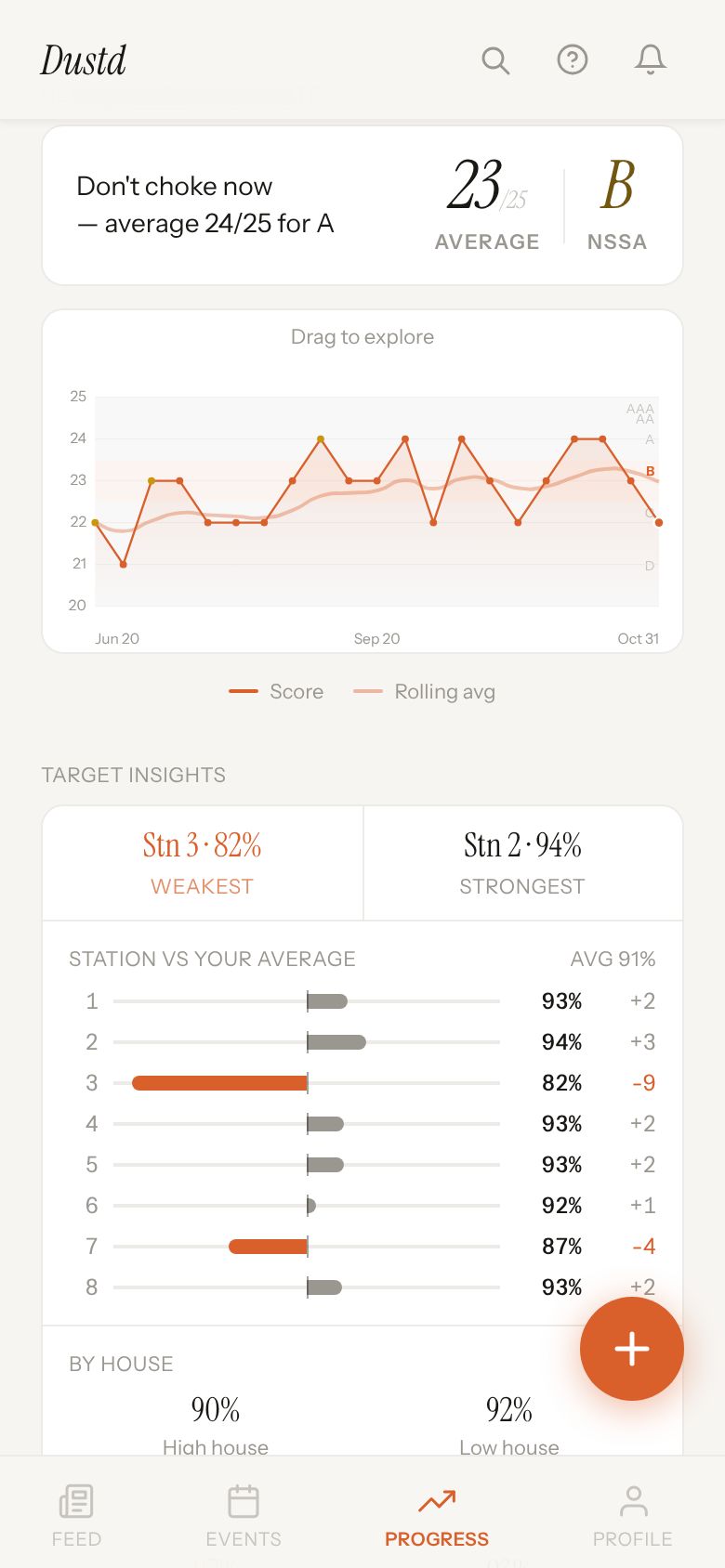
Find your weak stations with Dustd
- Score your rounds live in Dustd (+ then Keep Score, then Skeet), so every target is saved in order.
- Open the Progress tab and choose Skeet.
- Target insights show each station against your average and flag the weakest, plus high house vs low house and the first vs second target of your doubles.
- Take the weakest station to the field with this page, then watch its number move.
Where to shoot skeet
Find a club that offers it, or see what shoots are coming up.
Find clubs